|

HURRICANE GUSTAV PLAN FOR THE WORST WITH NOKR

For Immediate release:
Friday, August 29, 2008
Washington, DC USA
The Next of Kin Registry (NOKR) America’s central
repository for Emergency Contact information is
highly encouraging families and those with special
needs to register their loved ones and friends who
may be exposed to this potentially dangerous
hurricane.
Three years ago NOKR was a beneficial resource for
emergency agencies, thousands of families and
individuals displaced by Hurricane Katrina. NOKR
is also encouraging the media to help broadcast
this resource to those who may be in the path of
Gustav.
Registering with NOKR takes only a few minutes to
store those who should be listed as your emergency
point of contact for urgent situations. NOKR is
Fast, Free and Secure.
The Next of Kin Registry can be found on the
potential harm zone States, US Government and the
American Red Cross sites.
State of Texas
https://www.texasonline.com/portal/tol/en/gov/11/11
State of Louisiana
https://www.dhh.louisiana.gov/offices/page.asp?ID=145&Detail=5148
State of Mississippi
https://www.mississippi.gov/ms_sub_template.jsp?Category_ID=5
USA.gov is the U.S. government's official web
portal
https://www.usa.gov/Citizen/Topics/Family_Issues.shtml
American Red Cross
https://disastersafe.redcross.org/ServicePartners.aspx
NOKR’s President Mark Cerney said “ As we head
into Labor Day weekend I recall NOKR’s efforts
post Katrina, what we have learned is that
preparedness is a must do. We would like to ask
individuals and families to take 15 minutes and go
online to protect the ones you love and yourself
for the unforeseen”. Make registering with NOKR a
family event as you safeguard who you would like
to be notified during any emergency. For
travelers, those on vacations or at a temporary
residence they can register temporary information
and set an expiration date.
To register, or for more information, please visit
www.nokr.org.
About NOKR
The Next Of Kin Registry (NOKR) was established as
a FREE tool for daily emergencies and national
disasters. NOKR is your emergency contact system
to help if you or your family member is missing,
injured or deceased.
NOKR is a humanitarian non-profit 501(c)(3)
dedicated to bridging rapid emergency contact
information. NOKR was established in January 2004,
for daily emergency situations. NOKR is now listed
on more than 92% of all State websites, the
American Red Cross, Homeland Security
Disasterhelp.gov, USA.gov and other federal
agencies, as a critical resource for daily
emergencies. For more information please contact
Mark Cerney at (202) 730-9764 or visit NOKR's
website at www.nokr.org
NOKR Urges Registration
on Registry in Wake of Los Angeles Earthquake
NOKR
Communications Resource is Vital in Assisting the
Injured, Connecting Loved Ones
For Immediate Release:
Tuesday, July 29, 2008
San Diego, California USA
The Next of Kin Registry (NOKR), a national system
designed to assist local and state agencies to
access victims’ emergency contacts in devastating
tragedies is urging preparedness in California.
NOKR is also urgently reminding the general public
to register themselves and their loved ones in the
free system. The emergency contact registry can
be found on the California State website
www.ca.gov listed under (Living in CA) Next of
Kin.
“We are taking the invaluable lessons learned from
past natural disasters and are working to help
Americans better prepare for the future,” says
Mark Cerney, NOKR President. “Take a few minutes
to prepare today. They will prove to be the best
spent minutes of your day in making your family
safer.”
Giving officials and medical personnel a resource with
which to contact family, friends and relatives in
the aftermath of any emergency such as an
earthquake is vital to assisting both the injured
and those in search of their loved ones’
whereabouts. By giving emergency personnel fast
and efficient access to an individual’s emergency
contacts, rescue personnel can rapidly obtain
medical histories critical to saving lives.
Registration can also aid families whose loved
ones were tragically harmed, as not knowing their
fate only compounds the catastrophe.
To register, or for more information, please visit
www.nokr.org.
About NOKR
The Next Of Kin Registry (NOKR) was established as
a FREE tool for daily emergencies and national
disasters. NOKR is your emergency contact system
to help if you or your family member is missing,
injured or deceased.
NOKR is a humanitarian non-profit 501(c)(3)
dedicated to bridging rapid emergency contact
information. NOKR was established in January 2004,
for daily emergency situations. NOKR is now listed
on more than 92% of all State websites, the
American Red Cross, Homeland Security
Disasterhelp.gov, USA.gov and other federal
agencies, as a critical resource for daily
emergencies. For more information please contact
Mark Cerney at (202) 730-9764 or visit NOKR's
website at www.nokr.org
NOKR EXPANDS ITS MISSION
TO HELP FIND OUR NATIONS MISSING
For Immediate Release:
Tuesday, July 29, 2008
San Diego, California USA
NOKR has partnered with the National Center for
Missing Adults (NCMA) to become a force multiplier
in locating adults missing in the United States.
According to the (NCMA) an astounding 2,300
Americans are reported missing every day,
including both adults and children.
NOKR as the Emergency Contact Registry receives
phone calls daily from family members and
individuals missing due to Alzheimer's, Suspicious
Circumstances and sadly to Hurricane Katrina,
which displaced 447,827 individuals in both
Louisiana and Mississippi.
NOKR's mission is to store vital emergency contact
information for the pubic that is provided
securely to emergency agencies during times of
urgent need. NOKR is the central depository for
emergency contact information for the United
States; this is a free resource that is paid for
by donations.
NOKR's President Mark Cerney said, " NOKR has
partnered with the NCMA to serve our nations
missing by providing a louder voice. The NCMA is a
under valued and possibly unknown resource that
many families and individuals will never want to
utilize until the need may sadly occur."
A common misconception is that a person must be
absent for 72 hours before being legally classed
as missing, but this is rarely the case; in
instances where there is evidence of violence or
of an unusual absence, law enforcement agencies
often stress the importance of beginning an
investigation promptly.
Kym L. Pasqualini NCMA's President and founder has
volunteered to join the NOKR staff to become
NOKR's Director For Missing Persons. NOKR is a
100% volunteer work force with volunteers in 87
countries. Ms. Pasqualini's addition, in
conjunction with NCMA's support will allow NOKR to
better support the missing until they come home.
NOKR would also like to ask the public today to
help support this valuable service the NCMA's
provides our country as this agency relies on
donor funding to provide its services. To make a
donation please visit
www.theyaremissed.org
About NOKR
The National Next Of Kin Registry (NOKR) is a
humanitarian non-profit 501(c)(3) dedicated to
bridging rapid emergency contact information. NOKR
was established in January 2004, for daily
emergency situations. NOKR is now listed on more
than 92% of all State websites, the American Red
Cross, Homeland Security Disasterhelp.gov, USA.gov
and other federal agencies, as a critical resource
for daily emergencies. For more information please
contact Mark Cerney at (202) 730-9764 or visit
NOKR's website at
www.nokr.org.
About NCMA
The National Center for Missing Adults (NCMA) is a
division of Nation's Missing Children
Organization, Inc. (NMCO) - a 501c (3) non-profit
organization providing assistance to law
enforcement agencies throughout the country. The
National Center for Missing Adults (NCMA) was
formally established after the passage of
Kristen's Law (H.R. 2780) by the 106th United
States Congress on October 26th, 2000 (S11181). As
directed by H.R. 2780, NCMA operates as the
national clearinghouse for missing adults,
providing services and coordination between
various government agencies, law enforcement,
media, and most importantly - the families of
missing adults.




China quake prompts local
efforts to help out
Tuesday, May
13, 2008
As news of the
earthquake in China broke on
Monday, local Chinese and
other area residents with ties
to the country responded
quickly.
Jimmy Chen, a
businessman in Puyallup and
co-chairman of the Washington
State-Sichuan Province
Friendship Association, was
trying to organize a team of
disaster-relief experts and
rescue dogs to leave possibly
as soon as today.
Washington
state has had a sister-state
relationship since 1982 with
Sichuan province, where the
quake struck.
Gov. Christine Gregoire urged
Washington residents to help.
|
|
China quake relief
Mercy Corps:
Donate via www.mercycorps.org,
800-852-2100, or China Earthquake
Fund, Dept NR, P.O. Box 2669,
Portland, OR 97208.
World
Vision:
Donate via www.worldvision.org,
888-56-CHILD, or P.O. Box 9716,
Federal Way, WA 98063-9716.
Next Of Kin
Registry:
Free online service where family and
friends can register possible
victims/missing persons and contact
information. https://nokr.org.
|
| "Last
year, I had the honor of hosting a
delegation from Sichuan on the
occasion of the 25th anniversary of
our sister-state relationship,"
Gregoire said in a statement. "Even
though the earthquake victims are half
a world away, they are also our
neighbors."
The mega-city of Chongqing, where
deaths were reported, is sister city
to Seattle.
Yunbo Deng is a
board member of Chinese Microsoft
Employees, a group of about 2,500
people, many from mainland China.
The group is hoping
the company can match donations of aid
from employees, and hopes to partner
with other local organizations to
help.
On Monday morning,
Lu Zhao, a program manager at
Microsoft, talked to her parents in
Chengdu, the capital of Sichuan
province. Her father, a university
professor, told her most students had
been evacuated from the dormitories,
and her mother, a doctor at a
hospital, said patients had been moved
outside of the hospital.
Both Zhao's parents
were OK. She had been more concerned
about her grandmother, who lives in a
fifth-floor apartment.
"I worried about her
— how she would get out," Zhao said.
Zhao's aunt later found her at a
nearby park.
Other organizations
also are helping:
Both Federal
Way-based World Vision and
Portland-based Mercy Corps are
providing disaster-relief assistance.
|
Establish A Specific Meeting Place
Washington, DC
05/13/2008

A predetermined meeting
place away from your home will save time
and minimize confusion if your home is
affected or your neighborhood is
evacuated. Have you decided on a meeting
place? Does everyone in your family know
where it is? Be sure to include pets in
your plan. You should know that pets are
not permitted in emergency family
shelters, and some hotels will not accept
them.Have you held an emergency drill
and had everybody meet in your selected
place?
Store vital information in the next of
kin registry now – before the need arises.
You should also be aware of the
Next Of Kin Registry (NOKR) – a free
tool for daily emergencies and national
disasters. NOKR is an emergency contact
system to help if you or your family
member is missing, injured or deceased.
NOKR provides the public a free
registration service. Information you
provide is kept in a secure archive. You
can store emergency contacts, next of kin
and vital medical information that would
be critical to emergency response
agencies.
NOKR does not permit sharing
information for 3rd party distribution or
for personal gain. NOKR is a public
service tool for both citizens and
emergency agencies. NOKR is a
facilitation tool for those who cannot
speak directly to emergency personal. When
you store your minimal contact
information, the only viewer of this
information would be that of emergency
services.
|

May 01, 2008
Death notifications a daunting task for police
By
MELISSA VARGAS
Star-Telegram Staff Writer
|
There is a front doorstep
that Grapevine police
Capt. John Luna will never
forget.
As a rookie cop in San
Marcos, Luna sat in front
of that door for more than
two hours thinking about
how he was going to tell a
man that his wife of only
a few months was dead.
The 20-something's vehicle
was hit broadside while
she was on her way to cash
the first paycheck of her
teaching career.
"It was such a tragedy,"
Luna said. "Two young
people with their whole
lives ahead of them, and
it all came to a
screeching halt."
Death notifications are a
daunting task that
officers will likely face
at least once in their
careers.
The job is usually the
responsibility of
chaplains, grief
counselors or a medical
examiner. But sometimes
they aren't available. |
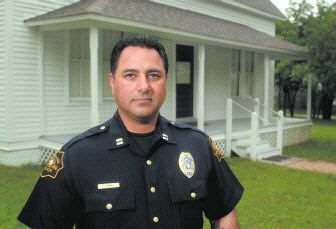
Grapevine police Capt.
John Luna still remembers
when he was a rookie
officer in San Marcos and
had to tell a man that his
wife of only a few months
was dead.
|
In
Texas, police officers are required
to have at least 618 hours of basic
training, but only minutes are
focused on death notifications,
depending on the instructor, said
Timothy Braaten, executive director
of the Texas Commission on Law
Enforcement Officer Standards and
Education.
"Each
situation is different," said Larry
Irving, chaplain for the North
Richland Hills Police Department.
"Sometimes it's strictly an
officer's judgment call."
Additional problems
In
the midst of the emotional trauma
involved during a death
notification, officers must make
sure that they are notifying the
right family.
If
the victim is not carrying
identification or is disfigured,
officers must take extra steps
before notifying the family. Many
times the medical examiner must step
in to handle the question of
identification.
A
mother's intuition or a sister's
bond may be enough to prompt
relatives to rush to the scene of a
tragedy, only to be frustrated when
police can give no final answers.
"The
only thing worse than making a death
notification, is making the wrong
one," Haltom City police Sgt. Terry
Stayer said.
Another difficult situation can
arise when families demand to see
the body immediately, said Roger
Metcalf, director of the human
identification laboratory at the
Tarrant County medical examiner's
office.
The
chief medical examiner can decline a
viewing if there's a biohazard
concern or evidence from criminal
investigations being collected.
Officials usually try to dissuade
relatives from seeing the body.
"Sometimes we let them, but we try
to discourage it because we don't
have a facility to really clean up
the body," Metcalf said. "We
encourage them to wait until the
body gets to the funeral home, but
sometimes they insist."
Metcalf deals with families who
oftentimes already suspect that
their loved one is dead when he
calls to confirm. If the victim is
local, an investigator will drive to
the family's home or officials will
contact the local police department
to make a death notification.
Memories
Officers have ways of coping with
the tragedies that make up their
careers, but many have experienced
incidents they can never forget.
Luna
can't remember the names of the
people involved in his first death
notification, but he can tell you
exactly where the house was. A
newlywed himself at the time, he
never forgot the numb, shock-filled
look on the man's face.
Stayer remembers going to a Haltom
City home to make a death
notification when she was a patrol
officer in 1997.
She
was called to an accident just after
midnight. A 17-year-old girl was
struck and killed by a car while
walking with friends along Denton
Highway. Stayer knocked on the door
of the girl's home, waking up her
mother, who believed the girl was
safe and sound in her bedroom.
"She
was devastated," Stayer said of the
grieving mother. "She just couldn't
believe what I was telling her. I
don't know how to describe it."
Sometimes, family members call
Metcalf searching for a loved one.
"There is one I will always
remember," he said. "A mother called
me to ask if we had her 17-year-old
daughter. She asked me to go down to
the morgue to tell her goodbye and
that the family loved her -- I did."
WHAT
YOU CAN DO
The
medical examiner's human
identification lab encourages
residents to sign up for the Next of
Kin Registry to make death
notifications easier and more
accurate.
The
registry, a global nonprofit
organization, offers the free
service, which is available securely
to registered emergency agencies
during times of urgent need. The
information can be accessed in the
following scenarios:
Missing or injured child, adult or
senior.
Those
suffering from dementia or
Alzheimer's disease.
Accidents while traveling nationally
or internationally.
Unconscious person unable to
communicate.
Natural disasters (hurricanes,
earthquakes, tornadoes, floods,
tsunamis and fires).
Terrorist acts, nationally or
internationally.
Next
of kin or point of contact
Phone registration:
800-915-5413
Online:
www.nokr.org
TRAINING
In
the law enforcement commission's
training manual, a section is
dedicated to teaching officers how
to deal with victims of crime and
accidents. In the lesson, officers
are taught to empathize, to answer
questions honestly, to call the next
day and to consider people's
feelings.
The
training also describes the victims'
phases of grief and what they need
from police during each phase. Among
the do's and don't are:
Don't
Tell
them everything is all right if it's
not.
Answer questions only if you have
full information.
Make
promises you can't deliver.
Insist on talking -- silence is OK.
Impose your religious beliefs or
personal philosophy.
Do
Say
"I'm so sorry that this has
happened."
Say
"I can't imagine how difficult this
must be for you."
Say
"I'd like to be with you for a while
if you don't mind."
Say
"Would you like me to help you with
...?"
Say
"It's not your fault."
|

 At The
End Of The Day,
It's All About Your Family.
At The
End Of The Day,
It's All About Your Family.



